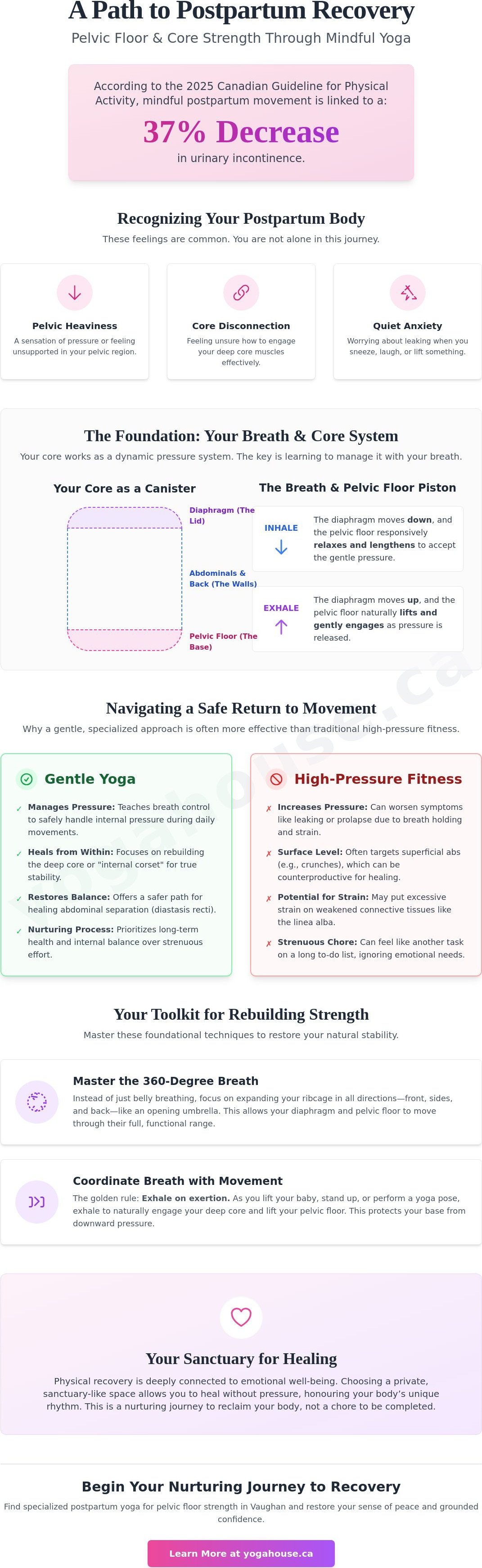
According to the 2025 Canadian Guideline for Physical Activity, engaging in regular, mindful movement postpartum is associated with a 37% decrease in urinary incontinence. You may currently feel a sense of heaviness in your pelvic region, a disconnection from your deep core, or a quiet anxiety about leaking during a sneeze or a lift. These feelings are common, yet they often leave mothers feeling isolated and uncertain about how to return to movement safely. Finding specialized postpartum yoga for pelvic floor strength Vaughan is often the first step toward moving from a place of fear to a state of functional, grounded confidence.
We believe that your recovery should be a nurturing process rather than a strenuous chore. You'll learn how to safely rebuild your pelvic floor strength and core stability through gentle, expert-led yoga movements that prioritize your internal balance and long-term health. This guide explores the vital connection between your breath and your pelvic floor, provides a sequence for functional core stability, and offers tools for emotional grounding (a necessary component of physical healing). Together, we'll map out a path that respects your body's unique rhythm and restores your sense of peace.
Key Takeaways
- Understand the "piston" relationship between your breath and your base to safely manage internal pressure during your daily movements.
- Identify why traditional high-pressure fitness routines may be counterproductive and how gentle yoga offers a safer path to healing abdominal separation.
- Practice specialized movements in postpartum yoga for pelvic floor strength Vaughan designed to engage your deep core and restore your natural stability.
- Discover the benefits of seeking a private, sanctuary-like space that prioritizes your emotional regulation alongside your physical recovery.
- Learn to coordinate intentional movement with your breath to rebuild your "internal corset" and improve functional strength for motherhood.
Reconnecting with Your Centre: The Postpartum Pelvic Floor
The pelvic floor is the quiet foundation of your entire internal system. Think of your core as a canister where the diaphragm acts as the lid, the abdominal muscles form the walls, and the pelvic floor serves as the sturdy base. During the cycles of pregnancy and birth, this base undergoes significant shifts in tension, position, and strength. It is entirely natural to feel a sense of "disconnection" from this region after delivery. You might feel heavy, unsupported, or simply unsure of how to engage these muscles again. Learn about the pelvic floor to better understand how these muscles provide essential support for your pelvic organs and stabilize your spine.
Healing is rarely a straight line. It is a slow, rhythmic process that requires both patience and specialized care. By choosing postpartum yoga for pelvic floor strength Vaughan, you are giving yourself permission to move at a pace that respects your body’s current state. This practice isn't about "fixing" something that is broken; instead, it's about nurturing a system that has performed an extraordinary feat. Re-establishing this connection is the first step toward feeling like yourself again.
Understanding Postpartum Changes in Vaughan
In our local community, mothers often ask how their specific birth experience affects their recovery. Whether you had a vaginal birth or a C-section, your core stability has been altered. A C-section involves a surgical transition through multiple layers of tissue, while a vaginal birth involves a significant stretching of the pelvic fascia (the connective tissue that supports your organs). Both paths affect the integrity of the linea alba, the tissue that runs down the centre of your abdomen. We encourage mothers to seek a pelvic health assessment alongside their yoga practice to realize their specific physical needs and ensure a safe, intentional return to movement.
The Emotional Aspect of Physical Recovery
The transition into motherhood is as much emotional as it is physical. When you feel physically weak or disconnected, it can deeply impact your mental well-being and your sense of self. Yoga serves as a gentle sanctuary where you can reclaim your body autonomy. It invites you to view your recovery as a nurturing journey rather than a chore on a long to-do list. By focusing on postpartum yoga for pelvic floor strength Vaughan, you are creating space for emotional grounding and physical restoration. This allows you to show up for your family from a place of replenished strength and internal peace.
The Breath-Pelvic Floor Connection: Why Your Diaphragm Matters
Many women are taught to treat the pelvic floor as an isolated group of muscles, but it actually functions as part of a rhythmic, living system. The diaphragm and the pelvic floor act like a piston moving in tandem within your body. As you inhale, your diaphragm moves downward to create space for air, and your pelvic floor should gently lengthen and relax in response. When you exhale, the diaphragm moves back up, and the pelvic floor naturally lifts. In our sessions for postpartum yoga for pelvic floor strength Vaughan, we begin every movement by reconnecting with this internal rhythm. It's the most foundational way to support your body's recovery from the inside out.
Holding your breath during exertion, such as lifting your baby or a heavy stroller, creates sudden downward pressure on your pelvic base. This habit, often done unconsciously, can strain the tissues and make symptoms like heaviness or leaking feel worse. When learning how to perform pelvic floor exercises, it's vital to start with the breath rather than just squeezing muscles. By mastering 360-degree breathing, you can manage intra-abdominal pressure safely, ensuring that your core supports you during every daily task.
Mastering the 360-Degree Breath
Instead of shallow chest breathing or "belly breathing" that pushes outward, we focus on lateral ribcage expansion. Imagine your ribcage as an umbrella opening in all directions, front, back, and sides. This expansion allows the diaphragm to move fully, which in turn encourages the pelvic floor to move through its full range of motion. Coordinating your exhale with a gentle, intentional lift of the pelvic floor is the "invisible" exercise that truly kickstarts your postpartum recovery. If you're looking for a quiet space to explore these rhythms, our private yoga sessions offer a sanctuary for focused, personal recovery.
Soothing the Nervous System
Physical repair cannot happen if the body is in a constant state of high alert. Deep, methodical breathing signals safety to the brain, allowing your muscles to release chronic tension and begin the work of healing. This is a core pillar of nervous system regulation yoga. By stimulating the vagus nerve through slow, intentional breath-work, you help organize your body’s internal state. This shift from "fight or flight" to "rest and restore" is essential for rebuilding functional strength and reclaiming your sense of peace during the often overwhelming transition into motherhood.
Navigating Safe Movement: Yoga vs. Traditional Fitness
Traditional fitness environments often prioritize high-intensity bracing and rapid repetitions, which can be jarring for a body in the midst of deep recovery. In contrast, the gentle engagement found in postpartum yoga for pelvic floor strength Vaughan focuses on subtle, intentional contractions that respect your current capacity. While a standard gym workout might encourage you to "power through" discomfort, our practice invites you to listen deeply to what your body is communicating. Traditional movements like crunches or sit-ups often create excessive intra-abdominal pressure. If your core cannot yet manage this load, it can lead to "doming" or "coning" along the midline of your stomach, which often worsens Diastasis Recti (abdominal separation). When we talk about "doming," we are referring to a visible ridge that appears down the centre of your abdomen during certain exercises. This indicates that the pressure inside your canister is pushing through the weakened connective tissue. We prioritize quality over quantity, ensuring every movement supports the integrity of your abdominal wall.
Why We Avoid High-Impact Early On
Gravity plays a significant role in your recovery. High-impact movements like jumping or running can place immense downward pressure on a healing pelvic floor, potentially leading to discomfort or a feeling of heaviness. Many experts emphasize the importance of postpartum healing and recovery during the fourth trimester, noting that the body needs time to reorganize its internal support structures. Yoga poses can be easily modified with props to provide stability, allowing you to build strength without the strain of high-impact activities. Seeking specialized postpartum yoga vaughan ensures you have the guidance to navigate these modifications safely while your body regains its natural resilience.
Identifying Red Flags During Practice
Learning to identify your body’s subtle red flags is a vital part of your practice. If you experience symptoms like pelvic heaviness, unexpected leaking, or sharp lower back pain, it’s a clear signal to slow down and reassess. We encourage a "pause and reset" mentality. This isn't a sign of failure; it’s an act of profound self-care and wisdom. It's better to perform three repetitions with perfect breath coordination than twenty with strained form. By staying attentive to these signals, you ensure that your journey toward postpartum yoga for pelvic floor strength Vaughan remains a restorative and safe experience, protecting your long-term health as you transition into the demands of daily motherhood.
Gentle Yoga Movements for Pelvic Floor and Core Stability
Rebuilding your foundation is less about intensity and more about the quality of your awareness. In our approach to postpartum yoga for pelvic floor strength Vaughan, we move away from the habit of "gripping" or "tucking" the abdominal muscles, which can actually increase downward pressure on your pelvic base. Instead, we focus on nurturing the Transverse Abdominis, the deepest layer of your core. These movements are designed to feel restorative, leaving you with more energy for your day rather than feeling physically drained. Every motion is a quiet, rhythmic conversation between your breath and your body, ensuring that your core remains a source of stability rather than a source of strain.
Re-establishing the Connection
Before we move into more complex shapes, we must first wake up the subtle lines of communication within the lower body. These three movements offer a gentle entry point for reconnecting with your centre:
- Pelvic Tilts: Lying on your back with knees bent, use a tiny, rhythmic rocking of the pelvis to find your neutral spine. This simple motion helps the deep core "check in" and release any holding patterns in the lower back without requiring high-pressure effort.
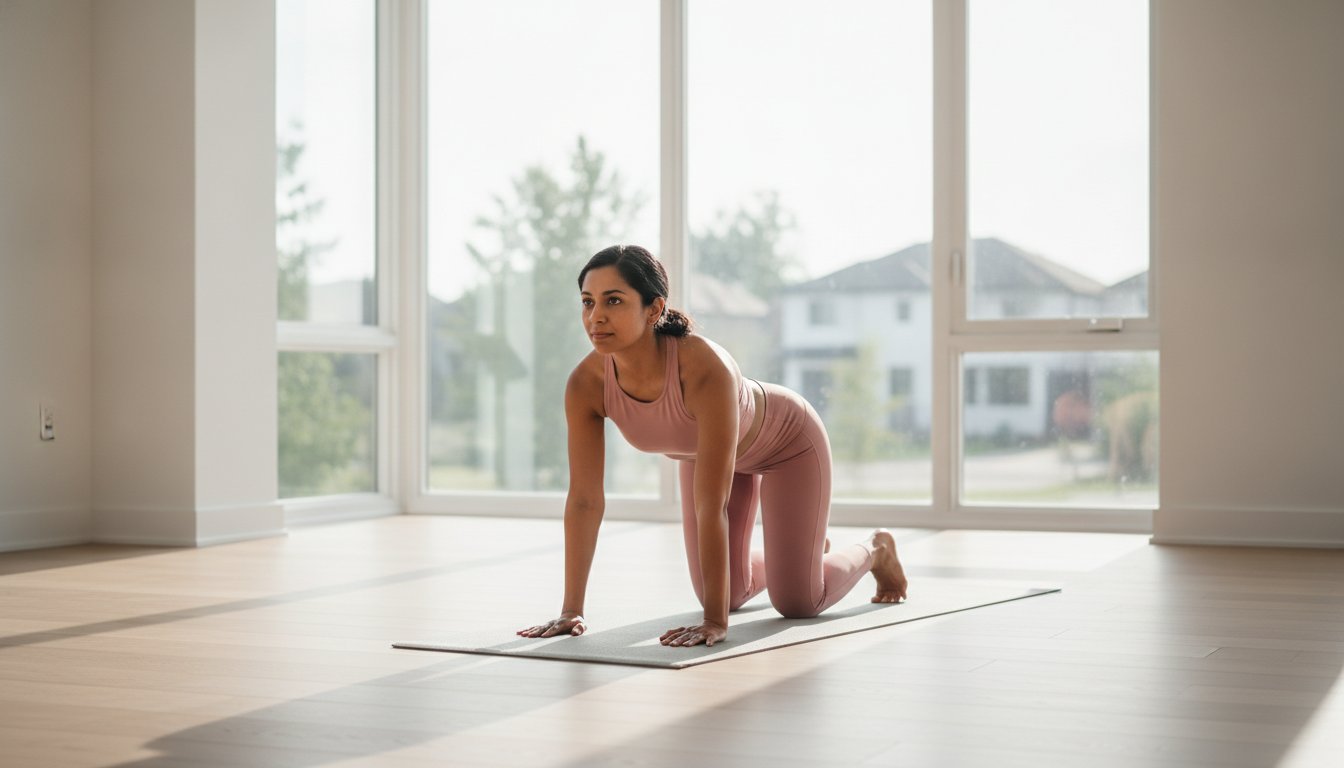
- Modified Cat-Cow: From a tabletop position, focus specifically on the exhale. As you breathe out, imagine a soft, magnetic lift of the abdomen toward the spine, coordinating this with the natural lift of the pelvic floor you've already practiced.
- Supported Bridge Pose: By placing a block or a firm cushion under your sacrum, you provide your body with helpful sensory feedback. This support allows the pelvic floor to realize where it is in space, encouraging a release of chronic tension while gently engaging the glutes.
Functional Strengthening
Once the connection is felt, we can begin to organize the body for the physical demands of motherhood. The Transverse Abdominis is your body’s natural internal support system, acting as a deep corset that wraps around your torso to stabilize your spine and organs. Strengthening this "corset" helps you move with more ease while carrying your baby or navigating your home in Vaughan.
- Heel Slides: While lying down, slowly slide one heel away from you and then back in, maintaining a steady, quiet core. This builds functional strength in the lower abdominals without the risk of "doming" or straining the connective tissue.
- Bird-Dog Variations: Extending opposite limbs while maintaining a level pelvis helps organize the spine and core for better posture. This is particularly helpful for counteracting the forward-leaning strain that often comes with nursing or holding a little one for long periods.
If you're ready to begin this journey in a quiet, supportive environment, we invite you to explore our postpartum yoga sessions tailored to your unique recovery needs.
Your Sanctuary for Postpartum Healing in Vaughan
Yoga House Canada was created as an intimate, private space where mothers can feel truly seen and supported during their recovery. Unlike large, high-energy fitness centres, our studio operates as a quiet sanctuary designed to lower your heart rate and settle your mind. We understand that every birth story is unique, and your recovery pace should be respected accordingly. When you join us for postpartum yoga for pelvic floor strength Vaughan, you aren't just another student in a crowd; you are a woman navigating a profound life transition who deserves specialized, compassionate care. Our environment is intentionally selective, prioritizing emotional safety and personal connection to ensure you feel grounded from the moment you step through our doors.
We believe in supporting the "whole mother," which means addressing your physical needs alongside your emotional well-being. By integrating restorative movement with mindfulness, we help you transition from a state of overwhelm to a place of internal balance. Whether you're seeking to regain functional core strength for the daily tasks of motherhood or simply need a moment of quietude, our sessions offer a methodical path toward readiness and ease.
The Value of Private Postpartum Instruction
A private setting is particularly beneficial during the postpartum period because it allows for precise form checks and tailored modifications that simply aren't possible in a large group. In this distraction-free environment, you can focus entirely on the subtle "piston" rhythm of your breath and pelvic floor without feeling rushed. This level of attention ensures that every movement is safe for your specific abdominal wall integrity. If you value personal attention but also enjoy a sense of community, our semi private yoga vaughan sessions offer a beautiful balance of small-group support and individualized guidance.
Integrating Sound and Stillness
Physical repair is deeply connected to the state of your nervous system. To facilitate a deeper release, we often incorporate elements of sound healing vaughan into our sessions. These resonant frequencies help settle the body, allowing your muscles to move out of a protective "gripping" state and into a restorative one. "Taking a pause" isn't a luxury; it's a vital part of the postpartum recovery protocol that allows your body the space it needs to organize its internal state. We invite you to experience this gentle approach to postpartum yoga for pelvic floor strength Vaughan by booking a private session at our studio, where your healing journey is always our primary focus.
Reclaiming Your Internal Stability and Peace
Your journey back to your centre is a sacred transition that deserves a gentle, methodical approach. By prioritizing the rhythmic connection between your breath and your base, you move beyond isolated exercises and into a state of functional, lasting stability. You now understand that your recovery is a holistic process, one that requires you to listen to your body’s subtle cues while avoiding the high-pressure bracing of traditional fitness. This intentional path allows you to rebuild your internal corset with patience and grace.
At Yoga House Canada, our nurturing specialists provide a private and semi-private sanctuary where your birth story is respected and your healing is prioritized. We integrate restorative movement with the soothing layers of sound healing and meditation to support your nervous system alongside your physical repair. If you're ready to step into a space that values depth and quietude, we invite you to Begin your gentle recovery with a private postpartum session at Yoga House Canada. Choosing postpartum yoga for pelvic floor strength Vaughan is a meaningful pause for yourself, ensuring you can show up for motherhood from a place of replenished strength. You've already taken the first step by being here; the rest of the path is yours to walk at your own beautiful pace.
Frequently Asked Questions
When is it safe to start postpartum yoga for pelvic floor strength?
Most women feel ready to begin a formal practice of postpartum yoga for pelvic floor strength Vaughan after their six-week medical check-up. While very gentle breathing exercises can often start sooner, it's vital to receive clearance from your healthcare provider first. Every birth story is different, and we prioritize your physical safety by ensuring your body has moved past the initial phase of acute healing before introducing more structured movement.
Can yoga help heal Diastasis Recti (abdominal separation)?
Yes, yoga is an excellent tool for managing abdominal separation because it focuses on the deep, internal engagement of the transverse abdominis. By learning to coordinate your movements with your breath, you can effectively manage intra-abdominal pressure and prevent the "coning" that often hinders recovery. This practice helps the connective tissue of the linea alba regain its natural tension and support your internal organs more effectively.
Do I need a referral from a doctor to start yoga in Vaughan?
You don't need a formal medical referral to begin a private or semi-private yoga session at our studio. However, we always recommend having an assessment with a pelvic health physiotherapist as part of your recovery team. This ensures that the specialized guidance we provide in our sanctuary is perfectly tailored to your internal healing and any specific clinical recommendations you've received.
What if I feel leaking or pressure during my yoga practice?
If you experience leaking, heaviness, or pressure, it's a gentle signal from your body to pause and reset. This sensation often indicates that the current movement is creating more internal pressure than your pelvic floor is ready to manage. In our private sessions, we'll immediately modify the pose or adjust your breath coordination to find a version of the movement that feels entirely safe and supportive.
How often should I practice these gentle core exercises?
Consistency is much more important than the duration or intensity of your practice. Engaging in mindful core and breath-work for fifteen to twenty minutes a few times a week can significantly improve your functional strength. The goal is to make these movements a natural part of your daily rhythm so they feel like a restorative pause rather than an overwhelming addition to your busy schedule.
Is postpartum yoga suitable if I had a C-section delivery?
Postpartum yoga is highly beneficial for those recovering from a C-section once the incision has fully healed and you have medical clearance. The practice focuses on gently releasing tension in the surrounding fascia and scar tissue while rebuilding core stability from the inside out. We use specific modifications to ensure that we're respecting the surgical transition your body has navigated while slowly restoring your strength.
What should I wear to a private yoga session at Yoga House?
We invite you to wear whatever soft, breathable clothing makes you feel most comfortable and at ease. You don't need high-performance athletic gear; simple layers that allow for a full range of breath and gentle movement are ideal. Our studio is a sanctuary for restoration, so we encourage you to choose attire that helps you feel grounded and relaxed during your time with us.
Can I bring my baby to my private yoga session in Vaughan?
Yes, you are more than welcome to bring your baby to your private session. We understand that finding childcare can be a barrier to self-care, and our space is designed to be a flexible sanctuary for both mother and child. Practicing with your baby nearby also allows us to explore how you can use mindful movement and breath-work during your actual daily tasks as a mother.