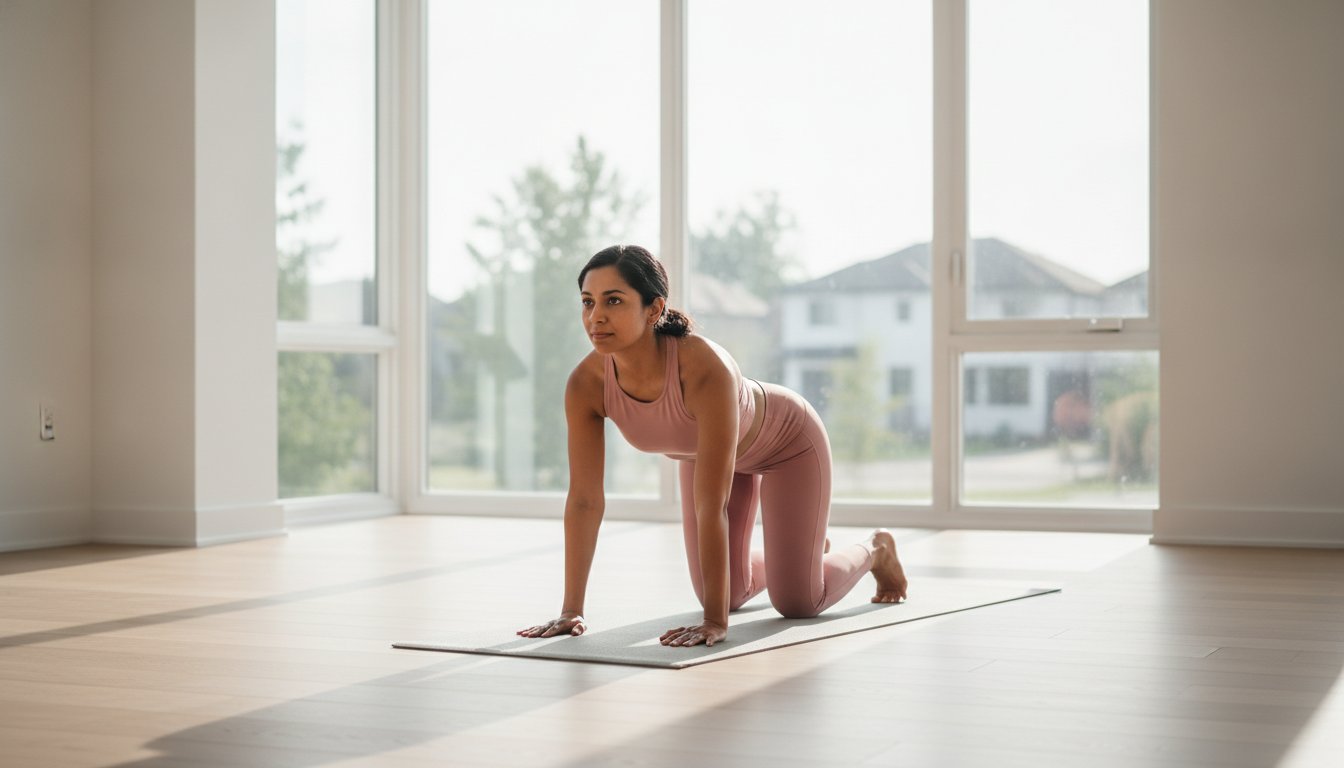
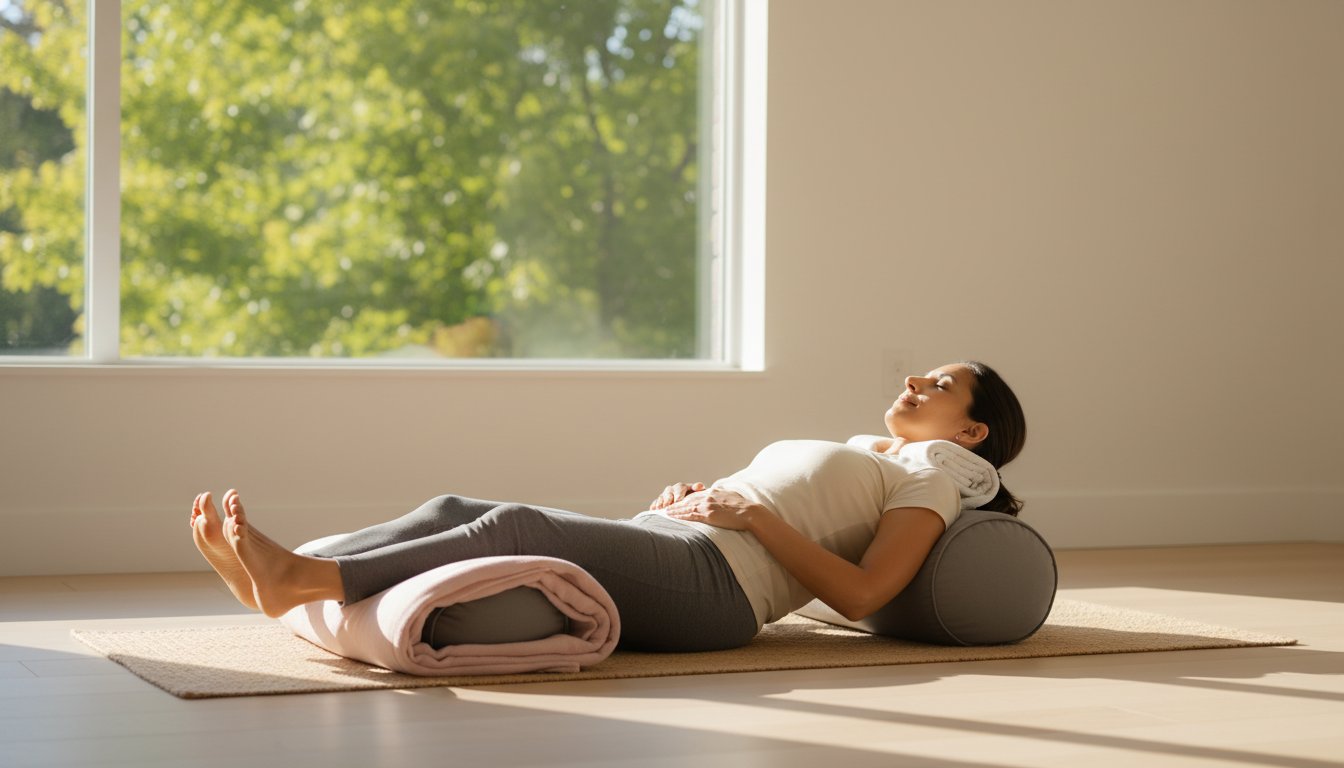
What if your constant state of exhaustion isn't a personal failing, but simply your body's way of telling you it has forgotten how to come home to itself? You likely know the feeling of being "tired but wired," where sleep remains elusive despite your fatigue and hormonal shifts leave you feeling emotionally frayed. It's an exhausting cycle to break alone, especially when your internal alarm system is stuck on high alert. This is why nervous system regulation yoga is so transformative; it offers a nurturing space to quiet the noise and restore your natural rhythms. Extensive research consistently highlights that dedicated yoga practice can significantly reduce stress levels and improve sleep quality, providing a scientific foundation for the relief you're seeking.
In this guide, you'll discover how these specialized practices can gently recalibrate your internal systems and move you out of a perpetual fight-or-flight response. We'll explore the science behind your stress, the restorative role of the vagus nerve, and the practical tools you need for lasting emotional regulation. By the end, you'll understand how a dedicated sanctuary for practice, such as the one offered by Yoga House Canada, can help you reclaim your internal sense of peace and transition from survival to serenity.
Key Takeaways
- Understand how to expand your "Window of Tolerance" so you can navigate life's transitions with greater ease and emotional stability.
- Discover how nervous system regulation yoga utilizes the Vagus nerve to physically signal your body to move from high alert to restorative rest.
- Learn why it's crucial to choose a private or semi-private environment to avoid picking up on the stress of others in crowded rooms.
- Explore the practice of "active non-doing" and how simple props can help you release deep-seated muscular tension and mental fatigue.
- Identify the essential elements of a nurturing sanctuary that support your journey toward lasting internal balance and peace.
Understanding Nervous System Regulation Yoga: Beyond Simple Relaxation
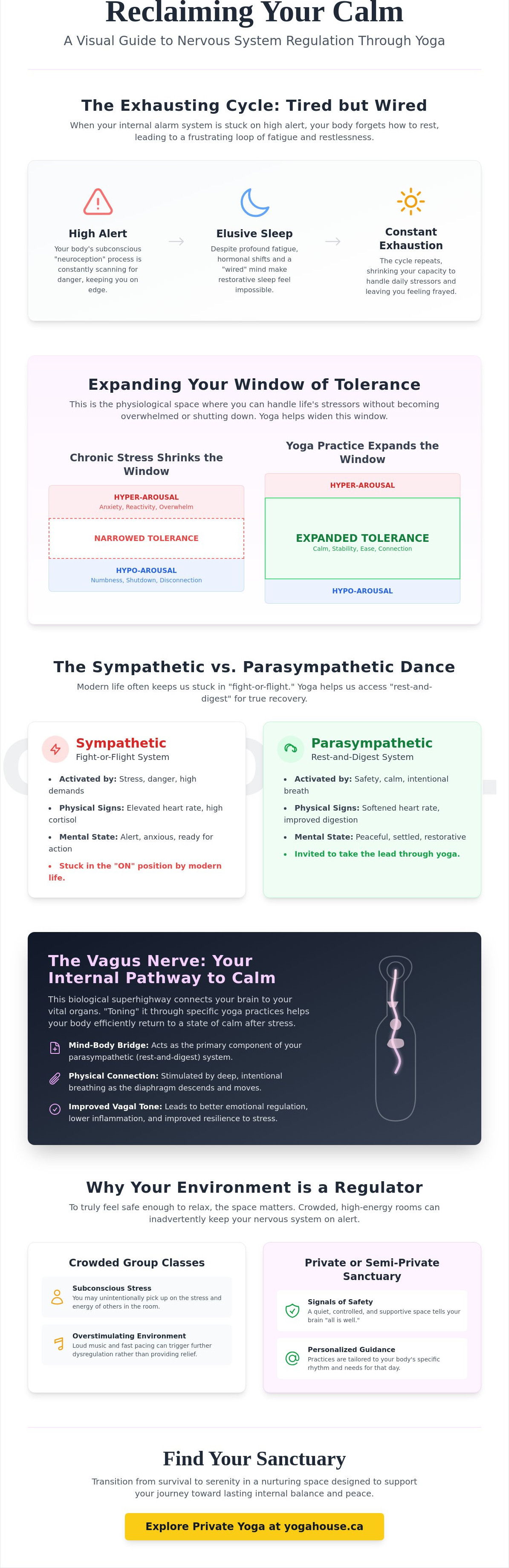
True nervous system regulation is far more than just "chilling out" after a long day; it's the refined ability of your body to move fluidly between states of high energy and deep rest without getting stuck in either. When we practice nervous system regulation yoga, we aren't just moving through physical shapes. We're engaging in a sophisticated dialogue with our internal wiring to restore a sense of safety and stability. This practice helps you expand your "Window of Tolerance," which is the physiological space where you can handle life's stressors without spiralling into anxiety or shutting down into numbness. When chronic stress persists, this window shrinks, leaving you feeling reactive, fragile, and perpetually on edge.
Your body is constantly performing a subconscious process called "neuroception," where it scans your environment for cues of safety or danger. It's a silent, internal surveillance system that operates beneath your conscious thought. In a therapeutic yoga setting, we prioritize creating a sensory environment that signals "all is well" to your brain. This is where the distinction between simple stretching and true regulation becomes clear. While stretching focuses on the lengthening of muscle fibres, regulation focuses on the state of the person inside the body. We use slow movements, intentional breath, and quietude to shift the internal landscape from survival to serenity.
The Science of Yoga reveals that these intentional practices can physically alter our stress response by modulating the autonomic nervous system. It's about learning to trust your body again, realizing that you have the internal tools to find your way back to centre when the world feels overwhelming.
The Sympathetic vs. Parasympathetic Dance
Our bodies are designed for a beautiful dance between the sympathetic (fight-or-flight) and parasympathetic (rest-and-digest) systems. However, modern life in a busy, growing centre like Vaughan often keeps our sympathetic drive stuck in the "on" position. Constant notifications, traffic, and endless to-do lists keep our heart rates elevated and our cortisol levels high. The goal of our practice is to gently invite the parasympathetic system to take the lead, allowing your digestion to improve, your heart rate to soften, and your mind to finally settle into a state of restorative peace.
Why Women’s Health Requires a Specialized Approach
Women's bodies navigate unique biological cycles that deeply influence nervous system sensitivity. Hormonal transitions, such as the shift into perimenopause or the profound changes of the postpartum period, can naturally sensitize your stress response. A "one-size-fits-all" gym class, often filled with loud music and high-energy pacing, can accidentally trigger further dysregulation rather than providing relief. Specialized Women’s Health Yoga or Postpartum Yoga offers a much-needed sanctuary. These practices respect your body's current rhythm, providing the soft, supportive environment necessary to reclaim your sense of safety and internal balance during life's most significant transitions.
The Science of the Vagus Nerve: Your Internal Pathway to Calm
Imagine a biological superhighway that travels from your brainstem all the way to your abdomen, touching your heart, lungs, and digestive organs along the way. This is the Vagus nerve, the primary component of your parasympathetic nervous system. It acts as a vital bridge between your body and mind. Understanding how yoga can help to regulate it is essential for anyone feeling stuck in a cycle of stress. Through nervous system regulation yoga, we can actually "tone" this nerve, much like we would strengthen a muscle. When the Vagus nerve is healthy and responsive, your body can transition back to a state of calm more efficiently after a stressful event.
The physical connection between your breath and your nervous system is found in the deep, rhythmic relationship between your diaphragm and your pelvic floor. As you take a slow, intentional breath, your diaphragm descends, gently stimulating the Vagus nerve as it passes through the thoracic cavity. This movement also creates a supportive response in the pelvic floor, which is often where we hold subconscious tension during times of uncertainty. By moving slowly and with purpose, you send a clear signal to your brain's primal centres that you are safe. There is no need to run or fight; you are allowed to simply be.
Polyvagal Theory and the Power of Connection
According to Polyvagal Theory, our nervous system operates in three distinct states. We might be in a "Safe and Social" state, a "Mobilized" state (fight-or-flight), or an "Immobilized" state (freeze). When you feel emotionally volatile or stuck in a rut, your system has likely moved out of that safe zone. A nurturing, private environment is vital for returning to balance. In a Private Yoga Session, the presence of a trusted guide allows for co-regulation. This is a beautiful process where your nervous system begins to mirror the calm, steady presence of your instructor, helping you feel secure enough to release deep-seated tension.
Breathwork as a Remote Control for the Brain
If your mind is racing, trying to "think" yourself into being calm rarely works. Instead, we use a "bottom-up" approach by changing the state of the body first to influence the mind. Your exhale is the key. While the inhale is slightly energizing, the exhale is inherently calming. By extending your breath out longer than your breath in, you directly engage the parasympathetic response. You can try a simple "Extended Exhale" right now. Breathe in for a count of four, then slowly release the breath for a count of six or eight. This simple shift acts like a remote control for your brain, slowing your heart rate and inviting a sense of quietude into your entire being.
Group Classes vs. Private Yoga: Why the Environment is a Regulator
Many believe that any yoga mat in any room will suffice for healing. However, the space around you is a silent participant in your journey toward balance. In a large, co-ed gym class, the sensory input can be unintentionally jarring. Bright fluorescent lights, the distant thud of weights, and the sheer volume of people can keep your nervous system on high alert. This is where nervous system regulation yoga diverges from a standard fitness routine. While physical activity is helpful, yoga also brings mental benefits that are only fully realized when the environment supports a profound sense of safety.
Our brains are naturally equipped with "mirror neurons," which allow us to subconsciously pick up on the emotional and physiological states of those around us. If you're in a crowded room where others are rushing, competing, or feeling self-conscious, your own body will likely mirror that underlying tension. A true sanctuary acts as a physical container for your peace. By carefully curating soft lighting, calming scents, and soothing sounds, a boutique studio provides the necessary cues to tell your brain that it's safe to let go. This personalized attention ensures that every pose is truly restorative, rather than another task to perform.
The Sensory Sanctuary in Vaughan
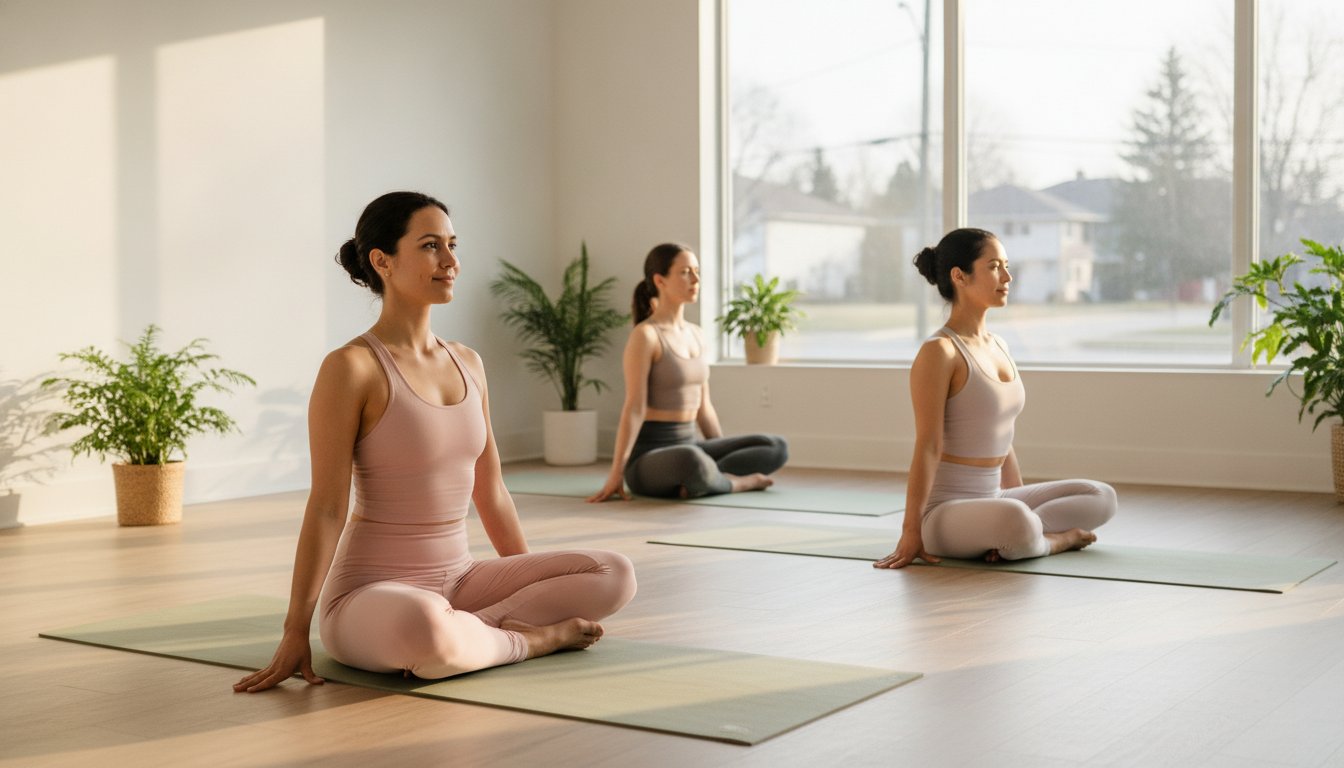
Because your nervous system is constantly scanning for cues of safety, a dedicated women-only space can significantly lower your internal "guard." When you remove the performance aspect of yoga, you're no longer worried about how you look or who is watching; you're simply feeling. This is why many women find solace in exclusive semi-private yoga in Vaughan. These intimate settings offer the social safety required for deep regulation, allowing you to breathe more freely in a space designed specifically for your comfort and privacy.
Personalized Instruction and Emotional Safety
In a private setting, your instructor can tailor the entire experience to your "Window of Tolerance" on that specific day. If you've had a particularly taxing week, the pace can be slowed to a whisper. We use trauma-informed cues and gentle, non-invasive guidance to ensure you always feel in control of your practice. These Private Yoga Sessions also allow for the seamless integration of other healing modalities. We might weave in Sound Healing or a guided Meditation to help anchor your focus, ensuring that the work we do on the mat translates into a lasting sense of emotional stability and quietude.
Restorative Modalities: Integrating Sound, Breath, and Movement
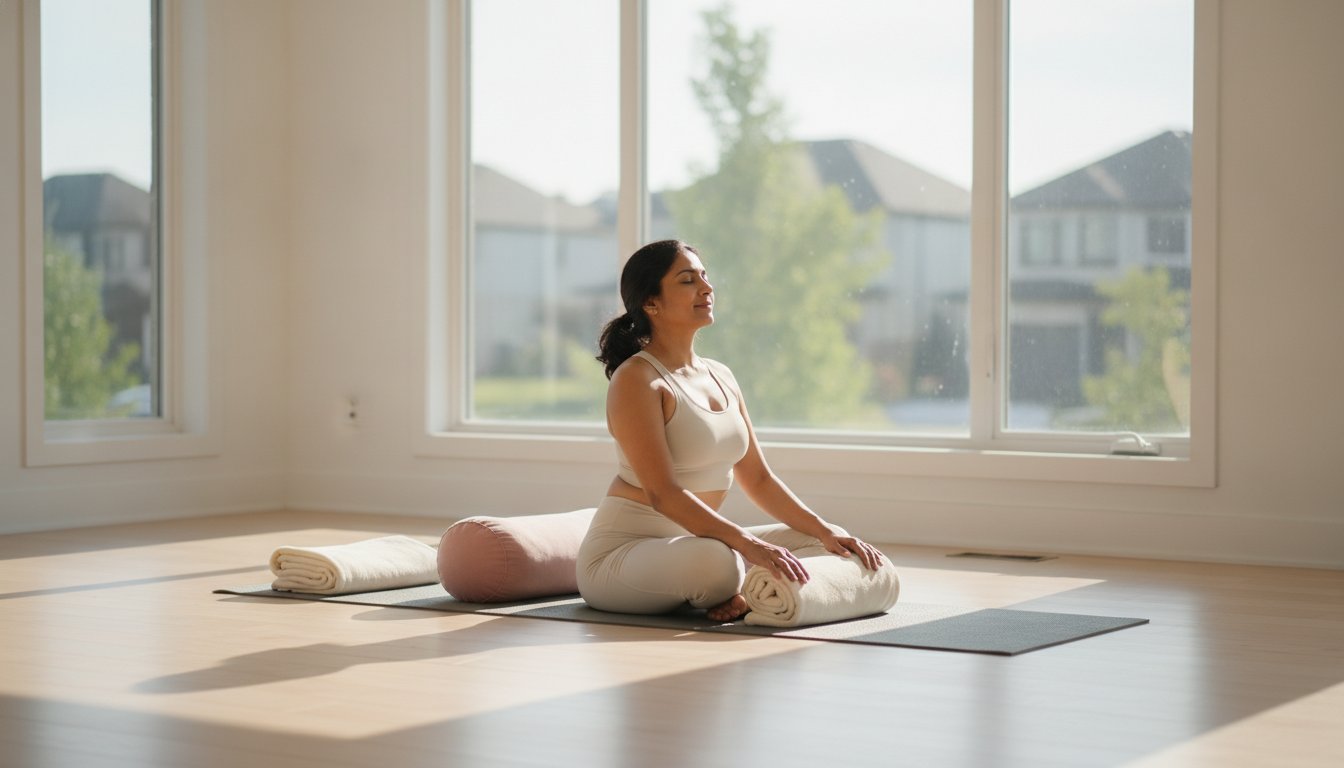
While many styles of yoga focus on the strength of the muscular system, nervous system regulation yoga prioritizes the quietude of the neurological system. A central pillar of this work is Restorative Yoga, a practice often described as "active non-doing." Unlike active flows that require effort, restorative practices use soft props like bolsters, weighted blankets, and eye pillows to provide total physical support. When your body feels completely held by the earth and these comforting tools, your brain receives a profound signal that it no longer needs to hold onto tension. This allows for a deep muscular release that simply cannot happen when you're standing or balancing.
To deepen this neurological reset, we often weave in the practice of Yoga Nidra, or "yogic sleep." A major 2026 scientific review of 73 studies confirmed that Yoga Nidra is a highly effective therapy for reducing stress and anxiety. Even a brief session can lead to measurable improvements in your internal balance. It's a guided journey into the space between wakefulness and sleep, where your brain can reorganize and recover from the "tired but wired" state that so many women carry through their daily lives.
The Vibrational Reset of Sound Healing
Sometimes, the analytical mind is too loud for traditional meditation to take hold. This is where the healing power of sound baths in Vaughan becomes an invaluable tool. By using the resonant frequencies of crystal bowls and gongs, we can synchronize your brain waves to a state of deep, meditative calm. The vibrations act as a gentle massage for your nervous system, bypassing your thoughts and working directly on a cellular level. In a sound-integrated yoga session, you don't just hear the peace; you feel it vibrating through your skin, helping to dissolve the emotional volatility that often accompanies chronic stress.
Yoga for Specific Life Cycles
Your nervous system doesn't exist in a vacuum; it's deeply intertwined with your hormonal health. For many, yoga for menopause relief serves as a cooling balm for a system that feels sensitized by heat and sleep disruption. Similarly, prenatal and postpartum regulation are foundational for maternal health, helping new and expectant mothers reclaim a sense of safety in their changing bodies. These specialized practices are not about pushing for a specific physical result. Instead, they are about honouring your body's current rhythm and providing the nurturing support needed to transition through life's cycles with grace and stability.
If you're ready to move out of survival mode and rediscover your internal sense of peace, we invite you to explore our private restorative sessions designed specifically for women's wellness.
Finding Your Sanctuary: Nervous System Support at Yoga House Canada
We have journeyed through the intricate science of the Vagus nerve, the importance of your "Window of Tolerance," and the profound way your environment acts as a silent regulator. Understanding these layers is the first step toward reclaiming your peace. Choosing nervous system regulation yoga is not merely about finding a new exercise routine; it's about choosing a specialized path that honours your body's need for safety and stability. By moving away from the noise of crowded gyms and into a space designed for quietude, you allow your system to finally let go of the "mobilized" state that modern life so often demands.
At Yoga House Canada, we believe that true restoration requires a sanctuary where you feel seen, cared for, and completely protected. Our boutique studio in Vaughan is curated to be that very place (a soft-lit environment where your heart rate can finally slow). By prioritizing intimate settings and personalized attention, we ensure that your practice is always a dialogue with your body rather than a performance for others. Whether you are seeking a Private Yoga Session or the gentle connection of a Semi-Private Yoga Session, you will find a rhythmic, unhurried pace that encourages deep neurological recovery.
A Nurturing Approach to Women’s Wellness
Our philosophy is rooted in being a guardian of your quietude. We understand that women’s bodies move through significant cycles that require specialized care and expertise. From the transformative journey of Prenatal Yoga to the restorative needs of Postpartum Yoga and Women’s Health Yoga, our approach is always gentle and intentional. You don't need any prior experience to begin regulating your nervous system with us. We meet you exactly where you are, providing the sophisticated guidance and humble support needed to navigate hormonal shifts or the exhaustion of new parenthood with greater ease.
Taking the First Step Toward Serenity
If you feel the call to move out of survival mode, we invite you to listen to that internal nudge. Your body knows when it's time for a meaningful pause. As of May 2026, Yoga House Canada has new member openings available for those seeking a more intimate, restorative practice. To ensure our small group setting (which is limited to a maximum of three participants) is a nurturing fit for your needs, we ask all prospective clients to complete a short inquiry form on our website. This deliberate, unhurried process allows us to maintain the sanctuary environment we have worked so hard to protect.
Taking this step is an investment in your long-term resilience. By learning to regulate your nervous system today, you are building a foundation of stability that will support you through every season of life. We look forward to welcoming you into our space, where you can breathe, release, and rediscover your internal sense of peace. When you are ready to begin, you can reach out to us here to start your journey toward balance.
Reclaiming Your Internal Sense of Peace
Restoring balance to a weary body requires more than just physical movement; it's a gentle process of honouring your physiological need for safety. We've explored how understanding the Vagus nerve and the "Window of Tolerance" provides the foundation for lasting change. By stepping away from the noise of crowded fitness environments and into a sanctuary designed for women's wellness, you give your brain the quietude it needs to reset. Nervous system regulation yoga offers a unique pathway to move from a state of chronic activation into a place of deep, restorative rest.
Whether you're navigating the transitions of perimenopause, the shifts of the postpartum period, or simply the weight of daily stress, you don't have to carry the burden alone. Our private and semi-private sanctuary in Vaughan is here to act as your guardian of quietude. Through the integration of Sound Healing, Meditation, and restorative movement, we help you cultivate the stability and peace you deserve. Begin your journey to serenity with a private session at Yoga House Canada. You've spent so long caring for the world; it's finally time to let yourself be cared for in return.
Frequently Asked Questions
What exactly does it feel like when your nervous system is regulated?
A regulated nervous system feels like a sense of groundedness and internal ease. You feel present in the moment rather than ruminating on the past or worrying about the future. Your breath is deep and steady; your muscles feel soft rather than braced for impact. It is a state of quiet alertness where you can respond to life's challenges with clarity instead of reactivity.
Can I practice nervous system regulation yoga if I have high anxiety and cannot sit still?
You can absolutely practice nervous system regulation yoga even if you struggle with stillness. We don't expect you to be perfectly calm immediately. Instead, we use gentle, rhythmic movements and specific breath patterns to slowly invite your system toward a state of rest. We meet you exactly where you are, offering a safe sanctuary where fidgeting is simply seen as your body's way of processing excess energy.
How often do I need to attend sessions to see a real difference in my stress levels?
While many clients report feeling a measurable shift after a single session, consistency is the key to lasting change. Research from 2026 confirms that even brief 11 minute sessions of yoga nidra show measurable results. Attending one to two sessions per week helps your brain build new neural pathways for calm. Over time, this practice expands your Window of Tolerance, making you more resilient to daily stressors.
Is this type of yoga safe for pregnancy or during postpartum recovery?
These practices are exceptionally safe and beneficial for both prenatal and postpartum recovery. We offer specialized Prenatal Yoga and Postpartum Yoga designed to support the unique physiological and hormonal shifts of motherhood. By prioritizing gentle, non-invasive movements, we help you reclaim a sense of safety in your body. This specialized support helps regulate the stress and emotional volatility that often accompanies these major life transitions.
Do I need special equipment or a certain fitness level to start?
No special equipment or athletic ability is required to begin your journey toward balance. We provide all the necessary props, including bolsters, blankets, and eye pillows, to ensure your body is fully supported. This practice isn't about flexibility or physical strength; it's about the internal state of your nervous system. Whether you're a seasoned practitioner or have never stepped on a mat, you are welcome in our sanctuary.
Why is sound healing often included in nervous system regulation sessions?
Sound healing is included because it uses vibrational frequencies to bypass the analytical mind and directly influence your neurological state. Instruments like crystal bowls help synchronize your brain waves to a frequency associated with deep relaxation. This sensory experience helps dissolve emotional tension and provides a shortcut to calm when your thoughts feel too loud. It is a powerful tool for those who find traditional meditation challenging.
What is the difference between a regular yoga class and a restorative session for regulation?
A regular yoga class often focuses on physical fitness and strength, whereas a restorative session for regulation prioritizes active non-doing. In a typical gym class, you might move through many poses quickly; in a regulation session, we use props to hold a few poses for longer periods. This approach focuses specifically on the Vagus nerve and the parasympathetic system to ensure you leave feeling truly restored rather than physically depleted.
How do I know if my nervous system is stuck in fight-or-flight mode?
You likely know you're stuck if you experience persistent difficulty sleeping despite exhaustion, constant irritability, or a feeling of being perpetually on edge. Other signs include digestive issues, a racing heart without physical exertion, and emotional volatility during hormonal shifts. If your internal alarm system never seems to turn off, your nervous system is likely trapped in a survival state and requires intentional nervous system regulation yoga to find balance again.